Bordeaux wine is a blended wine produced in the Gironde department of south west France, where the Bordeaux region gathers more than sixty appellations around the city of Bordeaux. Red Bordeaux dominates production, built on cabernet sauvignon, merlot and cabernet franc, while white Bordeaux ranges from dry sauvignon blanc to the sweet wines of Sauternes. This guide sets out the wine styles of the Médoc, Saint-Émilion and Pomerol, the grape varieties used across French wine regions and the official classification that still shapes what a bottle of red Bordeaux is worth.
What to keep in mind
- The Gironde estuary splits the Bordeaux wine region in two: cabernet sauvignon leads the left bank wine of the Médoc, merlot the right bank wine of Saint-Émilion and Pomerol.
- Almost every Bordeaux wine is a blend, which is why the same grape varieties give very different red wines from one appellation to the next.
- The 1855 official classification covers the Médoc, Sauternes and Barsac only; Saint-Émilion and the cru bourgeois run their own separate rankings.
- Bordeaux AOC and Bordeaux Supérieur account for a large share of the region's wine production and carry most of its everyday bottles.
What is Bordeaux wine?
Bordeaux wine is any wine made inside the delimited Bordeaux region, a wine region spread along the Garonne, the Dordogne and the Gironde estuary that they form together. The vineyard covers roughly 110,000 hectares, which makes it one of the largest appellation vineyards in France, and its wine production is overwhelmingly red. Red wine represents the great majority of the volume, ahead of dry white wine, sweet white wine, rosé and sparkling crémant.
The basics are quickly learned. Unlike Burgundy, where one variety usually fills the bottle on its own, Bordeaux wines are blends: a single bottle combines two or three grape varieties, and the proportion changes with the vintage. Second, the region is organised by place rather than by grape. A label rarely names cabernet sauvignon or merlot; it names an appellation, and the appellation tells an informed buyer which grape varieties are likely to dominate the bordeaux blend.
The regional appellations, Bordeaux AOC and Bordeaux Supérieur, can be produced across the whole Bordeaux region. Above them sit the communal and sub-regional names, from Médoc and Haut-Médoc to Saint-Émilion, Pomerol, Pessac-Léognan, Sauternes and the various Côtes de Bordeaux. Bordeaux Supérieur applies the same geography as Bordeaux AOC with stricter yields and a longer minimum ageing, which is why it often delivers a rounder red Bordeaux for the same kind of budget.
The grape varieties behind the Bordeaux blend
The bordeaux blend has been copied in California, Chile, Australia and South Africa, which says a great deal about how well these grape varieties work together. Each brings something the others lack: colour, tannic structure, aromatic lift or flesh in the middle of the palate.
Red grape varieties
- Merlot: the most planted variety of the whole Bordeaux region. It ripens early, gives supple tannins and plummy fruit, and carries the right bank.
- Cabernet sauvignon: thick-skinned, late-ripening, built for the warm gravel of the left bank. It provides the cassis fruit, the firm tannin and the ageing potential of a great Médoc château.
- Cabernet franc: aromatic and finer-boned, it adds a graphite and violet lift. It plays a leading role in some Saint-Émilion estates.
- Petit verdot: a small proportion goes a long way, adding dark colour, spice and tannic backbone to a left bank red wine.
- Malbec and carménère: historic varieties, now marginal in Bordeaux, kept by a handful of growers.
English speakers have called red Bordeaux claret since the Middle Ages, when the port shipped a pale wine known as clairet to London. Producers today guard the privacy of their blending trials, and few publish the final proportions before the wine is bottled. Press wine, the darker liquid drawn after the free run, is one of the last adjustments a producer makes, and old vine parcels are usually kept aside for the top wine of the estate.
White grape varieties
Sauvignon blanc supplies the citrus, the cut and the grassy edge of a dry white Bordeaux. Sémillon brings weight, a waxy texture and the thin skin that botrytis needs to make sweet wines. Muscadelle appears in small doses for its floral perfume. The same trio, handled differently, produces both the crisp bottles of Entre-Deux-Mers and the honeyed wines of Sauternes and Barsac.
Left bank: Médoc, Graves and Pessac-Léognan
North of the city of Bordeaux, the left bank of the Gironde estuary is a bank of deep gravel deposited by ancient glaciers. Gravel drains fast and stores heat, which suits cabernet sauvignon, and the estuary itself moderates frost. This is the home of the classic structured red bordeaux: firm when young, savoury and cedary after ten to fifteen years in a good vintage.
The Médoc is divided between the generic Médoc appellation in the north, the Haut-Médoc closer to the city, and six communal appellations. Pauillac gives the most emphatic cabernet, Saint-Estèphe the firmest tannins, Saint-Julien the most consistent balance, Margaux the most perfumed style, while Listrac and Moulis offer sturdy, honest wines that rarely make headlines. South of the city, Graves takes its name from its soil; its northern part became Pessac-Léognan in 1987, the only Bordeaux appellation classified for both red and white wine.
| Left bank | Right bank | |
|---|---|---|
| Leading grape | Cabernet sauvignon | Merlot |
| Soils | Gravel over clay | Clay and limestone |
| Key appellations | Médoc, Haut-Médoc, Pauillac, Saint-Julien, Saint-Estèphe, Margaux, Pessac-Léognan | Saint-Émilion, Pomerol, Fronsac, Castillon Côtes de Bordeaux |
| Young-wine character | Tannic, cassis, cedar, needs time | Plush, plummy, approachable sooner |
| Official classification | 1855 growths, cru bourgeois, Graves 1959 | Saint-Émilion classement, no ranking in Pomerol |
Right bank: Saint-Émilion, Pomerol and their satellites
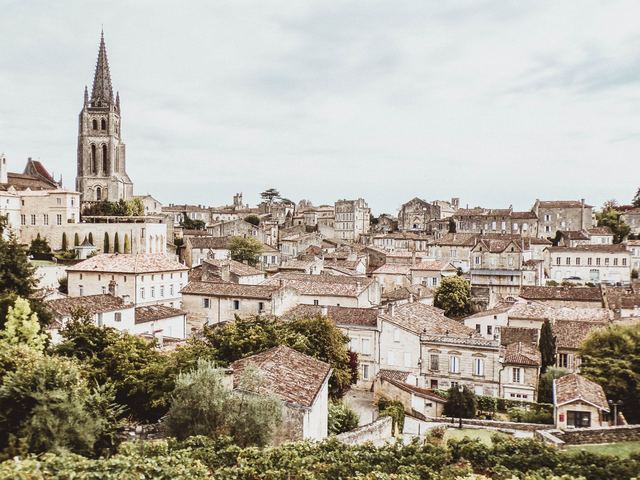
Cross the Gironde estuary and the geology changes. Clay and limestone replace gravel, cabernet sauvignon struggles to ripen, and merlot takes over. Saint-Émilion, a medieval town surrounded by a sea of vines, produces rounded red wines with velvety tannins, often drinkable five years earlier than a comparable Médoc château. Cabernet franc is the classic partner there, and on the limestone plateau it gives some of the most aromatic red bordeaux of the whole Bordeaux region.
Pomerol is tiny by comparison and has no official classification at all; reputation alone sets its hierarchy. A seam of iron-rich clay known locally as the crasse de fer gives the most sought-after estates their silky, truffle-scented signature. Around these two names, the satellite appellations of Lussac, Montagne, Puisseguin and Saint-Georges Saint-Émilion, together with Fronsac, Canon-Fronsac and the Castillon Côtes de Bordeaux, offer the same grape varieties and a similar style with far less competition from collectors.
White Bordeaux, dry and sweet
White Bordeaux deserves more attention than it gets. The dry white wines of Pessac-Léognan, barrel-fermented and built on sémillon and sauvignon blanc, age for a decade or more and rank among the most serious white wine of France. Entre-deux-mers, the wedge of land between the two rivers, is the source of brisk, unoaked bottles for oysters and summer lunches, while a plain Bordeaux Blanc covers everyday drinking across the region.
Sweet white Bordeaux is a separate craft. Autumn mists rising off the Ciron river allow Botrytis cinerea, or noble rot, to shrivel the grapes and concentrate their sugars. Sauternes and Barsac are the famous names, with Cadillac, Loupiac and Sainte-Croix-du-Mont producing lighter sweet wines nearby. Pickers go through the vineyard several times, berry by berry, which explains why these wines sit at the top of the range. If white styles are your entry point, our overview of white wines from grape to glass covers the same ground beyond Bordeaux.
How the official classification works
The 1855 classification was drawn up for the Paris Universal Exhibition, ranking the red wines of the Médoc, plus Château Haut-Brion from Graves, into five growths, and the sweet wines of Sauternes and Barsac separately. It has been amended once, when Mouton Rothschild was promoted to first growth in 1973. That near-immobility is both its strength as a brand and its weakness as a buying guide: a grand cru classé label tells you what a property was worth to brokers in 1855, not what the current owner is achieving.
Cru bourgeois and the other rankings
Other systems try to stay closer to the glass. The cru bourgeois ranking of the Médoc is now revised every five years across three tiers, and it is the most useful shortcut for anyone hunting value in left bank red bordeaux. Saint-Émilion revises its own classement roughly every decade, with promotions and demotions that regularly make the trade press. Graves has held a single list since 1959, Pomerol has none, and the Côtes de Bordeaux rely entirely on producer reputation. We compare two of these routes in detail in our piece on cru bourgeois against classified growths.
Bordeaux wine styles and food pairing
Food pairing in Bordeaux follows the structure of the wine rather than its label. A tannic left bank red wine needs protein and fat to soften it: lamb, rib of beef, duck, or a hard aged cheese. A merlot-led right bank bottle, with its rounder tannins, is more forgiving and handles roast poultry, mushroom dishes and charcuterie. Bordeaux Supérieur, served slightly cool, is a weeknight red for stews and grilled vegetables.
On the white side, an unoaked entre-deux-mers belongs with shellfish and goat cheese, while a barrel-aged Pessac-Léognan can stand up to scallops, turbot or a cream sauce. Sweet Bordeaux is the classic partner for foie gras and blue cheese, and it also works with a tarte Tatin. For a wider method, including the acid and sweetness rules that apply outside the region, read our practical guide to matching wine with food.
How to buy Bordeaux wines without overpaying
The reason to buy Bordeaux wines today is that the middle of the market is quietly excellent. Modern viticulture and a run of warm vintages have raised the floor: a serious Haut-Médoc or a Castillon estate now makes wine that would have passed for classified growth quality a generation ago. The gap between the top bordeaux wines and the tier immediately below is a question of reputation as much as of liquid.
Four habits make the difference when you shop:
- Buy the satellite rather than the star. Listrac instead of Pauillac, Puisseguin instead of Saint-Émilion, Fronsac instead of Pomerol: same grape varieties, same climate, different postcode.
- Use the vintage as a lever. Cooler years produce leaner, more classical red bordeaux that mature sooner and cost far less than a celebrated vintage of the same wine.
- Read the back label for the blend. Knowing whether a bottle is merlot-led or cabernet-led predicts the style better than the appellation alone.
- Match the bottle to the moment. Exceptional bottles reward patience and a decanter; the pleasure of a regional Bordeaux AOC is that it asks for nothing but a corkscrew.
Storage matters more with Bordeaux than with most French wine, because so many bottles are sold to be kept. A steady cool temperature, darkness and bottles laid on their side will preserve a wine for decades; a warm kitchen cupboard will exhaust the same bottle in two years.
Reading tasting notes before you buy online
Most people now shop for wine online, which means the tasting notes on a merchant page replace the shop counter and the producer standing behind it. A useful note describes structure before it describes fruit: it says where the tannin sits, how long the finish runs and whether the wine is ready to taste tonight. Vague adjectives teach you nothing, and a note that only praises the estate is marketing rather than a real tasting note.
Three signals are worth looking for in any selection. The producer and the exact appellation should both appear, since a selection that hides the producer is usually selling an anonymous bulk lot. The growing conditions of the vintage should be mentioned, because weather explains more about a wine than any medal. And the drinking window should be explicit: a bottle to purchase for the cellar is not the bottle to open with tonight's dish. If a page skips all three, contact the shop and request the details before you complete the purchase. A serious merchant keeps that information on file, will sign off on it gladly, and can tell you the address of the estate that made the wine.
Our own selection is organised along those lines, by producer, appellation and drinking window, so you can discover the Bordeaux region at your own pace without memorising a map of it. Start with a case that mixes one left bank wine, one right bank wine and one white: tasting them side by side teaches more in an evening than a shelf of books, and it is the perfect way to learn which style of wine suits your table.
Visiting the vineyards and the city of Bordeaux
A trip through the vineyards is the fastest way to understand why neighbouring appellations taste different. The classic tour out of the city of Bordeaux runs north along the D2, the road that links the great châteaux of the Médoc, then crosses the estuary towards the limestone plateau above Saint-Émilion. A second journey follows the Garonne south towards Sauternes, and a third explores the hills of the right bank. Any map of the region shows how short these distances are, and a self-drive tour of the three fits comfortably into a long weekend.
The visitor experience has changed a great deal. Many châteaux that once received the trade only now run a proper tour with a guide, and the local culture around wine has moved from a discreet cellar door to tasting rooms, vineyard walks and harvest days open to anyone who books ahead. The city itself, whose historic port area is a UNESCO World Heritage site, has become the heart of any wine trip, with the Cité du Vin museum on the quayside as a starting point and no shortage of inspiration for the rest of the adventure. Take the time to explore a cooperative as well as a famous name: the story of Bordeaux is told as much by its thousands of small producers as by its first growths, and their wines are often the ones you can take home the same day.
Questions buyers ask about Bordeaux wines
Is Bordeaux wine always red?
No. Red wine accounts for the great majority of Bordeaux wine production, but the region also makes dry white wine, sweet white wine, rosé, clairet and sparkling crémant de Bordeaux.
How long should a Bordeaux be kept?
It depends on the tier. A regional Bordeaux AOC is made for the first two or three years, a good Bordeaux Supérieur or cru bourgeois drinks well between three and eight years, and a classified Médoc château from a strong vintage often needs a decade before it opens up.
What is the difference between a grand cru classé and a cru bourgeois?
A grand cru classé belongs to a fixed historic ranking, chiefly the 1855 official classification of the Médoc and the Saint-Émilion classement. Cru bourgeois is a separate Médoc ranking, revised every five years, which makes it a better reflection of recent quality and the usual hunting ground for value.
Which grape varieties are allowed in a Bordeaux blend?
For red Bordeaux: merlot, cabernet sauvignon, cabernet franc, petit verdot, malbec and carménère. For white Bordeaux: mainly sémillon, sauvignon blanc and muscadelle. Growers blend within those lists according to the vintage.