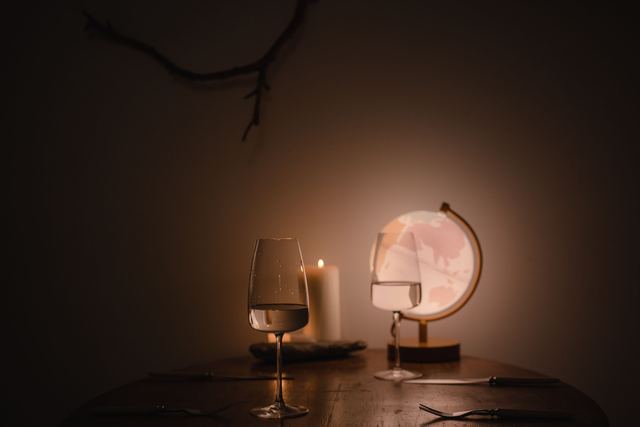
Wine glasses are measuring instruments for aroma: the bowl sets the liquid surface, the rim and the lip reveal what reaches your nose, the stem holds the temperature. Crystal buys thinness, not magic. For a red, a white or a champagne, size matters at tasting, and cleanliness matters more than any shape.
What holds up under scrutiny
- Fill any wine glass to a third: that geometry reveals the largest liquid surface and leaves the headspace aroma needs.
- Size, rim diameter and a thin lip are measurable. Grape specific red wine glasses and white wine glasses mostly are not.
- Two sizes of crystal wine glasses, plus a tulip for champagne and sparkling wine, cover almost every bottle you open.
- Detergent residue and cupboard smells reach the wine before the wine does. Care beats shopping, at home and at a tasting.
- What a sommelier checks first is the lip, then the smell of the empty glass. The silhouette comes last.
Why a third of the way up is the right fill
Aromas are volatile compounds. They have to evaporate off the surface of the wine before anything reaches you, and they need somewhere to gather once they do. Any glass filled to roughly a third does both at once: it exposes the widest possible liquid surface for the volume poured, because that volume sits at the broadest part of the bowl, and it leaves a column of still air above it where those compounds concentrate. That is the whole reason a tasting pour looks small, in crystal or in plain glass, for a red as much as for a white.
Filling to the brim reverses the arrangement. The surface is now at the narrowing top of the bowl, so it is smaller, and there is no headspace left for anything to collect in. It also removes swirling, which is nothing more mysterious than forcing evaporation to happen faster by spreading a film of wine up the sides.
The habit reads as meanness at a table. It is arithmetic. A generous pour into a large bowl is still a third of the glass, and a small bowl filled halfway holds less wine than a large one filled to a third.
What are the types of wine glasses?
Catalogues list dozens. In practice the types of wine glasses that behave differently from one another come down to four families, and the differences between them are about volume and rim diameter rather than silhouette.
Red wine glasses
Red wine glasses are the largest of the family, and the size is doing real work: tannic and aromatic reds carry more volatile compounds and benefit from a bigger evaporating surface and a longer air column. A broad bowl with a rim clearly narrower than its widest point suits a reserved wine that needs coaxing. A tulip that tapers more gently suits an exuberant style that would otherwise arrive as a wall of scent. Burgundy shaped bowls, the wide ones sold for pinot noir, exaggerate the effect; whether that flatters your bottle is a matter of taste rather than physics. A structured Bordeaux, at the other end, shows its flavours perfectly well in a straighter sided glass, which is why so many professional tasting sets never leave that shape.
White wine glasses
White wine glasses are smaller, and here the reasoning is temperature rather than aroma. A smaller pour in a smaller bowl spends less time in your hand and in the room, so it stays near the temperature you chose. Aromatic whites still want a real bowl. The tall narrow glass sold as a white wine glass in restaurants is usually a compromise with the dishwasher rack, not with the wine.
Champagne glasses and sparkling wine
Champagne glasses are the clearest case of fashion outrunning function. The narrow flute preserves the visual column of bubbles and very little else, because the rim is too tight for aroma to escape at any useful rate. A tulip, or simply a modest white wine glass, gives a champagne far more room to smell like what it is. Bubbles still form, they simply spread out. The coupe, meanwhile, loses both aroma and effervescence. If you keep a champagne flute for the look on special occasions, keep a second option for anything you actually want to taste, and see our guide to the styles and houses behind French sparkling wine for what those bottles are built to show.
The universal glass
A single well proportioned shape, around the size of a modest red wine glass with a rim a third narrower than the bowl, handles reds, whites and sparkling wine without embarrassing any of them. A matched wine glasses set of one shape is the most useful thing a household can own. Two sizes is a luxury. Twelve is a collection, not a system.
The bowl gathers, the rim delivers
Everything above reduces to two measurements. A wide bowl exposes more surface, so more aroma leaves the wine. A rim narrower than the bowl funnels what rises toward a smaller opening, so more of it arrives at your nose instead of the room. The ratio between the two is the only shape variable worth paying attention to.
The thickness of the rim matters more than most buyers expect, and it is easier to judge than any curve. A fine rim lets wine arrive on the tongue without an announcement. A thick rolled edge, the kind that survives commercial washing, puts a lip of glass between you and the liquid and changes where the wine lands in the mouth. Run a finger over the rim in the shop. You will feel the difference in a second, and it is the single feature most reliably correlated with what a good glass costs to make.
Stem thickness and base weight are comfort, not performance. A stemmed glass set that feels stable on a table is worth having; a heavy base does nothing to the wine.
Crystal glassware, glass, and what the difference buys
Crystal contains a mineral additive, historically lead and now more often barium, zinc or titanium, which lowers the melting point and lets the material be worked thinner and clearer. That is the whole advantage, and it is a real one: elegant crystal wine glasses can be blown to a thinness ordinary soda lime glass cannot reach without becoming fragile in the wrong way. A red wine glass in crystal will have a finer rim than its counterpart in standard glass at the same size.
Modern crystal glassware sold for the table is lead free. The trade offs that remain are practical. Crystal is softer, so it scratches and clouds more readily. It is more porous, which is exactly why residue and smells matter more. Many crystal wine glasses are machine washable, and the manufacturer says so in the product specifications; some are not, and the difference is in the material and the joint between bowl and stem rather than in the price.
Ordinary glass is not a compromise if the proportions are right. A well shaped glass tumbler set will outperform a badly shaped crystal one on every measure that affects taste. Shape first, material second.
The stem is not decoration
A hand wrapped around a bowl warms the wine inside it within minutes. That undoes the care taken to chill a white, and it pushes a red past the point where alcohol starts to dominate the nose. Holding the stem costs nothing, needs no equipment, and is the single easiest habit to acquire in the whole of wine service.
Stemless glasses exist because they stack, survive dishwashers and do not tip over. They are honest about their purpose. They also guarantee hand contact with the bowl, so use them for wine you intend to drink rather than consider, and keep them away from anything you have taken the trouble to bring to the right temperature.
Grape specific glasses deserve scepticism
Ranges designed around a single variety are a commercial proposition more than a measurable one. Blind comparisons repeatedly show that tasters can tell a large bowl from a small one, and a fine rim from a thick one, and struggle beyond that. The differences that survive scrutiny are the ones already listed: volume, rim diameter, and thinness of the glass. A pinot noir does not reveal a different set of flavours because the bowl bears its name, and neither does a Bordeaux.
None of those requires a different shape for every bottle. Buying by grape means owning many glasses that differ in ways you cannot perceive, and washing them all. The same budget spent on fewer, thinner glasses produces a difference you will notice on the first pour. What genuinely changes a wine in the glass is time and air, which is why knowing when a bottle is worth decanting is a better investment of attention than a fifth shape of bowl.
What a sommelier actually checks
Watch a sommelier pick up unfamiliar stemware before a tasting and the sequence is always the same, and it is short. A thumb goes over the lip to feel its thinness. The glass is held to the light, which will reveal clarity and any residual film. It is then smelled empty, because a glass that carries the smell of a cupboard will reveal that, and nothing else, to the first pour. Only after that does anyone look at the silhouette.
That order is worth copying at home, and it explains why professional choice rarely matches catalogue marketing. A tasting room in Bordeaux or Burgundy will often use one modest shape for everything, because comparability across flights matters more than flattering any single bottle, and because a room full of matched glasses can be washed to the same standard. Country of origin, handmade or machine blown, premium brand or supermarket, none of it survives the thumb test if the lip is thick.
Handmade glasses are thinner at the rim and more variable in capacity; machine blown ranges are consistent and easier to replace when one breaks. Engraving, coloured stems and other drinkware flourishes are decoration and sometimes a hiding place for residue. The same goes for the rest of the cabinet: carafes, cocktail glasses and a chef's collection of specialist shapes each solve a real problem, and none of them reveal anything about a bottle of wine that a clean, thin glass will not. If you want a single practical rule for tasting at home, pour the same measure into every glass on the table and compare the flavours you can name, not the shapes you can see. Our walk through a tasting, from glass to tasting room sets out the rest of the sequence.
Which glass for which wine
| Glass | Bowl and rim | Suits | Worth owning? |
|---|---|---|---|
| Large red wine glass | Wide bowl, rim clearly narrower | Robust red styles, aged bottles, aromatic reds | Yes, the workhorse |
| Medium white wine glass | Smaller bowl, moderate taper | Whites, roses, lighter reds served cool | Yes, if you drink white often |
| Tulip for sparkling wine | Narrow base, bowl then gentle taper | Champagne and every serious sparkling wine | Yes, replaces the flute |
| Champagne flute | Tall, narrow throughout | Visual effect, toasts, special occasions | Optional, not for tasting |
| Grape specific ranges | Variations on the two above | Collectors and restaurant floors | Rarely, past the first two shapes |
How to care for wine glasses
Care is where most of the damage happens, and it is entirely within your control. The enemy is residue: anything left on the inside surface reaches the wine before the wine reaches you.
Rinse immediately after use with very hot water and no detergent. Hot water alone removes wine from glass perfectly well, and skipping detergent removes the main source of contamination in one step. Where a glass has held something oily or has sat overnight, use the smallest possible quantity of unscented detergent and rinse far longer than feels necessary.
Dry with clean linen rather than leaving glasses to drain. A cloth that has dried near cooking, or one washed in scented softener, will deposit exactly what you were trying to avoid. Keep one cloth for glassware and nothing else. Hold the base, not the bowl, while you polish, and turn the glass rather than twisting the stem; most breakages happen at the sink and at the joint.
The dishwasher is not automatically the enemy. Many machine washable ranges survive years of it, provided the load is loose, the temperature is moderate, the rinse aid is left out and the glasses come out before the drying cycle bakes on whatever the water left behind. Check what the manufacturer states for your range, then trust the durability of the joint rather than the reputation of the material.
Storage ruins more glasses than shape ever did
A cupboard that smells of cardboard, of a damp wall or of last week's spices will hand that smell to the first wine poured into any glass stored in it. Glass is not neutral over time; it holds whatever air sits against it.
Store upright. Upside down, a glass traps stale air against its most fragile edge and puts the weight of the whole bowl on the rim you paid for. On a shelf, leave enough space that glasses never touch, since the commonest chip is caused by a neighbour rather than a fall. If a set is stored for a season, rinse and dry before use rather than after, because the dust of months does more than the wine of one evening.
A faulty bottle will still taste faulty in a perfect glass, and it is worth being able to tell the two apart. Our note on how to recognise cork taint and the other common faults covers the smells that come from the bottle rather than from the shelf.
Buying without overbuying
Decide how many glasses you will realistically wash by hand, then buy that number in the thinnest version you can afford, in one shape. A set of six well made glasses outlasts and outperforms two dozen mediocre ones, and it fits in a cupboard where nothing touches.
If you buy wine glasses online, the product specifications carry the answers the photograph will not: capacity, rim diameter, overall height, material, and whether the range is machine washable. Capacity is the one most often misread, because a glass described as generous may simply be tall. Read the return terms and the privacy policy of the retailer the way you would read a wine label, since the detail is where the surprises live. Check the country the range is made in, whether the glasses are handmade or machine blown, and what the return window is for breakage in transit. Buy one glass and live with it for a moment before you select twelve of an unfamiliar shape, and treat a premium brand name as a starting point rather than a guarantee.
Glassware also makes a durable gift, and a perfect gift for someone who already owns bottles is usually a better glass rather than another bottle. A pair of fine rimmed glasses says more than a box of six thick ones. A chipped lip is the one sign that a glass has stopped being worth keeping, whatever the brand on the base, and the moment to retire it is before it reaches a guest. If you are assembling something for a celebration, our selection of wines chosen to be given pairs naturally with a single well chosen glass.
Finally, remember what the glass cannot fix. Temperature is decided before the wine ever reaches it, and the most common fault at a table is a red served too warm rather than a bowl of the wrong width. The guide to serving temperatures by style is the cheapest upgrade available to anyone who already owns a decent glass.
Questions readers ask
How many wine glasses do I actually need?
One shape, in the quantity you can wash by hand after a dinner. Six of a single universal shape covers reds, whites and sparkling wine. A second, smaller shape is a genuine improvement if you drink white regularly; a third is a preference.
Are crystal wine glasses better than ordinary glass?
Crystal can be worked thinner and clearer, which produces a finer rim at the same size. That is a real advantage on the tongue. It is not worth anything if the bowl and rim proportions are wrong, and crystal scratches and clouds more easily, so shape comes first and material second.
Should champagne be served in a flute?
Not if you want to smell it. The rim of a champagne flute is too narrow to release aroma at any useful rate. A tulip or a modest white wine glass keeps the bubbles and gives the wine room to express itself.
Can wine glasses go in the dishwasher?
Many ranges can, and the manufacturer states it. Load loosely, keep the temperature moderate, skip the rinse aid and remove the glasses before the drying cycle. Hand rinsing in very hot water with no detergent remains the safest method for thin stemware.
Does the shape of a glass really change the taste of wine?
Size, rim diameter and rim thickness change what you smell and where the wine lands in the mouth, and those are perceptible. Differences between grape specific shapes within the same size are far harder to detect, and most blind comparisons do not find them.