A wine glossary is the working list of terms used to describe how a wine smells and tastes, how it was made and what its label is allowed to claim. Most of these wine terms describe something tangible in the glass: a texture, an aroma, a sugar level, a place. Learn a few dozen and a tasting note, a wine list and a French appellation stop being guesswork.
Start here if you only read one part
- Four words carry most tasting notes: acidity, tannin, sugar and alcohol. Everything else describes how they sit together.
- French label terms are legal categories, not marketing: appellation, cru and millésime each have a defined meaning.
- A wine fault is not a matter of taste. Cork taint and oxidation are measurable, and a faulty bottle is replaceable.
How this wine glossary is organised
This glossary of wine terms follows the path a bottle actually takes: first the vocabulary of tasting, then the words that describe structure in the mouth, then winemaking terminology, then what the label states about region, grape variety and quality. Sparkling, sweet and fortified wine terms come next, and the list closes with faults, storage and service.
Wine vocabulary for beginners suffers from two problems. Some terms are French words kept in English because no translation exists, such as terroir or cuvée. Others are ordinary English words used in a narrow technical sense, such as dry, body or nose. Both types are defined here in plain language, with the common wine descriptions you will meet on shelf tags and in tasting rooms. Nothing in this wine glossary requires a sommelier diploma to use, and understanding wine terminology takes far less time than most drinkers expect: the key words number in the dozens, not the hundreds. If you want to see these terms in action, our step by step guide to tasting a wine walks through a single glass from sight to finish.
Wine tasting terms: aroma, nose and palate
Tasting vocabulary describes what the smell and the taste of a wine register, in that order, because most of what we call taste is actually smell.
- Nose is everything you perceive by smell before the wine reaches your mouth. A closed nose gives little; an expressive nose gives a lot.
- Aroma refers to the scents that come from the grape itself, typically fruit, flowers and herbs. Primary aromas belong to the variety, secondary aromas come from fermentation, and tertiary aromas appear with age in bottle.
- Bouquet is the complex aroma an older wine develops over time: leather, undergrowth, dried fruit, tobacco.
- Palate is the wine in the mouth, from first contact to the moment you swallow.
- Finish is how long the taste lasts after swallowing. A long finish is one of the few reliable markers of quality across every wine style.
- Legs or tears are the streaks a wine leaves on the glass. They indicate alcohol and sugar content, nothing about quality.
- Blind tasting means judging a wine without seeing the bottle, the standard way to remove expectation from a verdict.
Tasting notes string these wine terms together in a fixed order: appearance, nose, palate, finish. Once you recognise the pattern, a professional note stops reading like code and starts reading like a description of a specific glass of wine.
Structure in the mouth: acidity, tannin, sugar and alcohol
Four measurable components decide how a wine feels. Winemakers call them structure, and every balanced wine holds them in proportion.
- Acidity is the fresh, mouth-watering quality that keeps a wine lively. Tartaric acid and malic acid are the main acids in grape juice; a wine low in acidity tastes flabby, one high in acidity tastes taut.
- Tannin is the drying, sometimes gripping sensation in red wine. It comes from grape skins, seeds and oak, and acts as a natural preservative that lets a red wine age. Firm tannins need time in the cellar; soft tannins drink well young.
- Residual sugar is the sugar left unfermented when the yeast stops working. It is what separates a dry wine from a sweet wine.
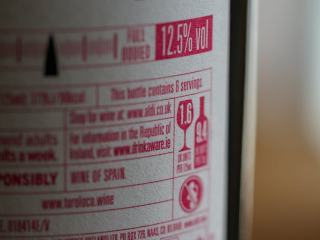
- Alcohol by volume is the alcohol content printed on every wine bottle. Higher alcohol adds weight and warmth; very high alcohol can leave a burning sensation at the back of the mouth.
- Body describes the weight of the wine on the palate. A light bodied wine feels like skimmed milk, a full bodied wine like cream.
- Balance is the term for a wine in which none of these elements stands out on its own.
| Sweetness term | What it means in the glass | Typical examples |
|---|---|---|
| Dry | No perceptible sugar, fermentation taken to completion | Most red wines, Sancerre, Chablis |
| Off-dry | A trace of sugar that rounds the acidity | Many Alsace and Loire white wines |
| Medium sweet | Sugar clearly present but not dominant | Vouvray demi-sec, some Rieslings |
| Sweet | High residual sugar carried by firm acidity | Sauternes, late harvest dessert wine |
Winemaking terms from grape juice to finished wine
Winemaking terminology describes a process, and the terms related to winemaking follow it in sequence. Understanding winemaking makes half of any wine glossary self-explanatory.
- Harvest is the picking of the wine grapes. A late harvest leaves the fruit on the vine to concentrate sugar.
- Fermentation is the conversion of grape sugar into alcohol and carbon dioxide by yeast cells. It is the single step that turns juice into wine.
- Maceration is the contact between juice and grape skins that gives red wine its colour and tannin. Carbonic maceration ferments whole clusters in a carbon dioxide rich tank and produces the bright, low tannin style associated with Beaujolais.
- Malolactic fermentation is a secondary fermentation that converts sharp malic acid into softer lactic acid. It is standard for red wine and optional for white wines, where it brings a creamy texture.
- Sur lie means the wine rests on its dead yeast deposit, adding body and a faint bready character. Muscadet is the classic French example.
- Oak barrel ageing adds vanilla, spice and gentle oxidation through the wood. Stainless steel does the opposite: it preserves fruit and keeps the wine bright.
- Pressing extracts the remaining juice from the grapes. What stays behind, the pomace, is the solid mass of skins, seeds and stems.
- Blending assembles different lots into the final cuvée. In Bordeaux this is the norm, not the exception.
Two more terms cover clarification. Fining removes suspended particles with an agent that binds to them, and filtration passes the wine through a fine mesh. Both affect clarity and, in small measure, texture. Natural wine production minimises or skips them, which is why a natural wine can look cloudy without being faulty.
Wine label terms: appellation, classification and quality tiers
A French wine label is a legal document. These wine label terms tell you what the rules allowed the producer to do.
- Appellation, in full Appellation d'Origine Contrôlée, designates a defined wine growing area with binding rules on grape varieties, yields, alcohol levels and winemaking methods. It is a geographical indication, not a quality score.
- Cuvée means a specific blend, batch or selection. A prestige cuvée is a producer's top bottling.
- Cru means a vineyard or a village recognised for its quality. Premier Cru sits above village wine, Grand Cru above that in Burgundy, Alsace and Saint-Émilion.
- Cru Classé refers to the 1855 classification of Bordeaux wine estates, still in use today.
- Vieilles Vignes, meaning old vines, is a French term with no legal minimum age. It usually signals lower yields and more concentrated fruit.
- Millésime is simply the vintage, the year the grapes were picked.
- Mis en bouteille au château confirms the wine was bottled at the estate rather than shipped in bulk.
- Table wine is the lowest legal category, free of appellation rules and free to blend across regions.
Other countries organise the same information differently. German labels rank wines on the Prädikat scale, which sorts them by the sugar level of the grapes at harvest rather than by vineyard, while Italian bottles use DOC and DOCG as their geographical indication. The French system describes a place, the German one describes ripeness, and knowing which logic applies tells you what the label is promising.
Each of these wine terms appears in a fixed position on the bottle, which makes them easy to find once you know the layout. Our page on what each line of a French label actually states maps them field by field.
Wine regions and grape varieties named on the bottle
French wine regions are named on the label instead of the grape variety, which is why the same Cabernet Sauvignon appears as Bordeaux on one bottle and as a varietal wine on another.
- Terroir bundles soil, subsoil, slope, aspect, drainage, micro-climate and local tradition into one idea: the sense of place a wine expresses.
- Varietal describes a wine named after a single grape variety. A blend is named after its region instead.
- Red grape varieties behind most French red wines include Cabernet Sauvignon and Cabernet Franc in Bordeaux, Pinot Noir in Burgundy and Syrah in the northern Rhône Valley.
- White grape varieties include Sauvignon Blanc and Chenin Blanc in the Loire, Chardonnay in Burgundy and Champagne, and Riesling in Alsace.
- Minerality describes a stony, chalky or saline quality, common in wine produced on limestone soil such as Chablis or Sancerre.
- Vineyard, winery and viticulture name three different things: the planted plot, the building where the wine is made, and the craft of growing the vines. Organic viticulture excludes synthetic treatments in the vineyard and is certified plot by plot.
- Old World and New World separate the historic European regions from later producers such as Napa Valley, Chile or Australia. Pinot Noir grown in each yields a recognisably different wine.
Wine grape varieties behave differently in each of the wine growing regions that host them, which is the whole argument for naming the place rather than the plant. A tour of the main French grape varieties and the regions that suit them shows how far the same variety can travel in style.
Sparkling, sweet and fortified wine terms
Three wine styles use their own vocabulary because they involve an extra step after the first fermentation.
- Secondary fermentation in a sealed wine bottle traps carbon dioxide and creates the bubbles of Champagne. The method is called traditional method, or méthode traditionnelle.
- Dosage is the small amount of sugar added after disgorging a sparkling wine. It sets the final style, from brut nature to demi-sec.
- Noble rot, or botrytis, is a beneficial fungus that shrivels ripe grapes and concentrates their sugar. It produces the great sweet wines of Sauternes.
- Late harvest, vendanges tardives in French, leaves healthy grapes on the vine until sugar levels climb.
- Fortified wine has neutral spirit added during or after fermentation, which stops the yeast and raises the alcohol content. Port, sherry and the vins doux naturels of southern France all belong to this family.
Sparkling wines, sweet wines and fortified wines all keep longer once opened than a standard dry wine, because sugar, bubbles or alcohol each slow oxidation in their own way.
Faults, storage and service terms
A wine fault is a measurable defect, not a question of taste, and these are the terms used to name one.
- Cork taint, caused by the compound TCA, gives a wet cardboard smell and strips the fruit. A corked wine is always returnable.
- Oxidation is prolonged contact with air. A little brings complexity; too much turns a white wine brown and flattens its aroma.
- Sediment is the natural deposit an older red wine throws in the bottle. It is harmless and is the reason for decanting.
- Decanting pours the wine into another vessel to leave sediment behind, and lets a young wine breathe through contact with air.
- Serving temperature changes everything: too cold and a red wine shows only tannin, too warm and it shows only alcohol.
- Wine cellar conditions mean a stable temperature, decent humidity, darkness and no vibration.
- Aging, also spelled ageing, is the slow chemical change a wine undergoes in bottle. Cellaring is the practice of storing wine for that purpose, and only a minority of bottles improve with aging; most are made to drink within a few years.
Glassware belongs here too. A wine glass with a bowl wider than its rim concentrates aroma towards the nose, which is why the same wine can smell different in two glasses. Which bottles genuinely need air is covered in our guide to decanting and the wines that benefit from it.
Wine glossary questions readers ask most
What are the most common wine terms to learn first?
Dry, sweet, tannin, acidity, body and finish cover most tasting situations. With those six wine terms you can describe almost any glass accurately enough for a merchant or a sommelier to find you something similar.
Does dry wine mean the wine is not fruity?
No. Dry refers only to the absence of residual sugar. A dry wine can smell intensely of fruit while tasting completely dry, which is why ripe Californian reds are so often described as sweet by people who mean fruity.
What is the difference between aroma and bouquet?
Aroma comes from the grape and the fermentation, bouquet develops with age in the bottle. A young wine has aromas; an old wine has a bouquet.
Why are so many wine terms in French?
Because the categories they name were defined in France first. Terroir, cuvée, appellation and cru have no exact English equivalent, so the French word travelled with the concept.
How do I know if a wine will age well?
Acidity, tannin and concentration are the three markers, and the vintage matters as much as the producer. Our vintage guide to strong and difficult years sets out which harvests reward patience.